
Book Review: BP Process Safety Series, Nitrogen Hazards and Catalyst Handling
شکیلا بختیاریNovember 1, 2015تازه های نشر
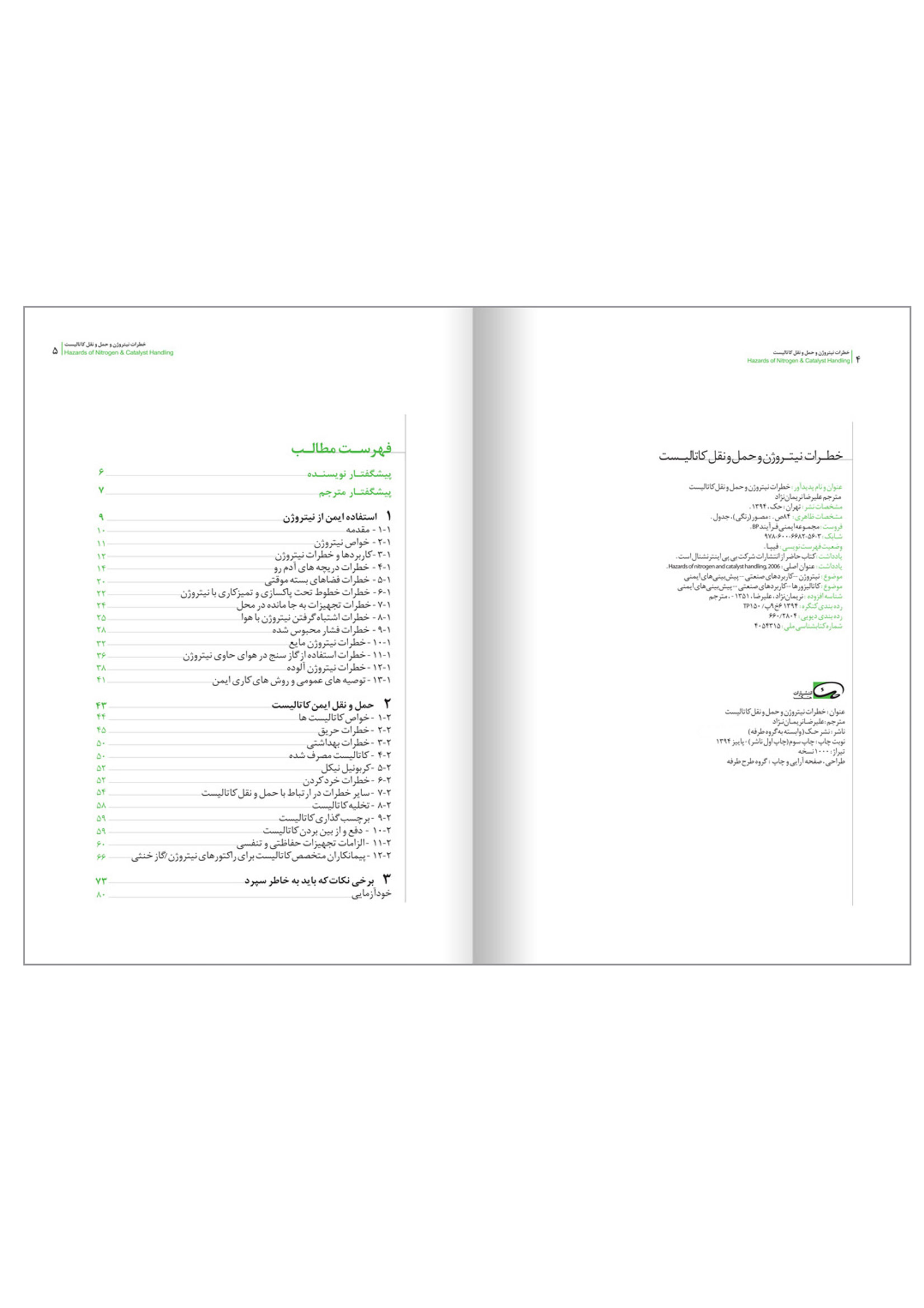
The atmosphere in which we live, the air we breathe daily, consists of 79 percent nitrogen, 21 percent oxygen, and small amounts of other gases. But only oxygen is necessary and vital for human respiration and survival.
Without sufficient oxygen—that is, if the oxygen level falls below 16 percent—we will die of asphyxiation.
Nitrogen gas in the atmosphere acts to some extent like a diluent or buffer gas. Nitrogen on its own is inert, stable, non-reactive, and non-toxic, but excess nitrogen reduces the amount of oxygen and creates an invisible condition that can be deadly.
If the earth were without nitrogen and filled only with oxygen, fires would be beyond our control and steel structures would rust rapidly.
Therefore nitrogen is an effective diluent or buffer gas without which we cannot live, but an excessive amount of it deprives us of vital oxygen, which can lead to asphyxiation and even death within a few seconds.
Nitrogen is used extensively for various purposes in refineries and petrochemical complexes. For example, it is used to provide an inert, neutral atmosphere, to purge vessels of hydrocarbons, and to create a protective blanket on storage tanks in order to prevent explosions and fires.
Nitrogen is colorless and odorless and can be deadly and lethal without warning. It is therefore known as the "invisible killer," having caused many deaths in refineries around the world; it is also one of the most dangerous gases present in refineries and chemical plants.
This book serves as a supplementary appendix to training courses and work instructions, and the aim of compiling it is to help readers better understand the reasons for using safe work instructions and the relevant regulations in facilities.
It also contains useful information regarding the design and engineering of units. Technical recommendations and other changes have been made after the publication of this book and, while they have not affected the principles, may affect some of the opinions and recommendations presented.
In the present book, the reader is encouraged to consider such developments when applying the safety instructions and principles to their own equipment.
While the information in the said book is intended to increase the body of knowledge of safe operation, it is important for the reader to keep in mind that this material is general and not specific to a particular unit.
As noted, the book's information supplements training programs and should not be regarded as a substitute for training courses, operational instructions, or operating principles, and the recommendations presented in it are only the author's personal view; they should not be treated as a statement or declaration.
https://irannashr.com/main/product/%d8%ae%d8%b7%d8%b1%d8%a7%d8%aa-%d9%86%db%8c%d8%aa%d8%b1%d9%88%da%98%d9%86-%d9%88-%d8%ad%d9%85%d9%84-%d9%88-%d9%86%d9%82%d9%84-%da%a9%d8%a7%d8%aa%d8%a7%d9%84%db%8c%d8%b3%d8%aa/
Comments
No comments yet.
To leave a comment, please sign in.