
Book Review: Heavy Metals in the Environment
شکیلا بختیاریApril 30, 2015تازه های نشر
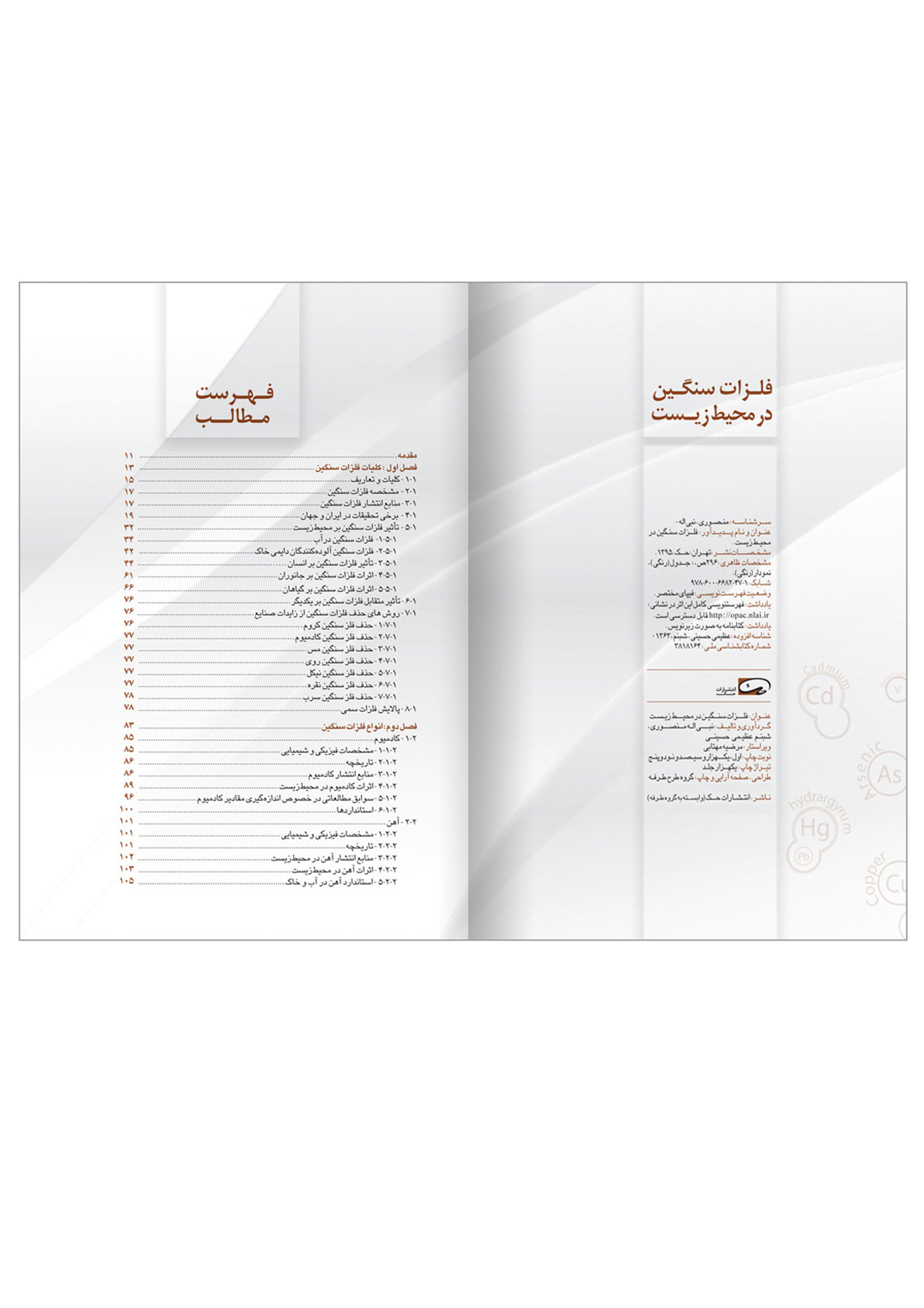
Among various researchers there is no single, unique definition for heavy metals. Heavy metals have been defined on the basis of density, weight, or atomic number, periodicity, and other physical characteristics, and even toxic effects.
Heavy metals are elements with metallic characteristics and high atomic weight.
Their atomic number is usually above 20 and below 92.
According to Hawkes's definition, metals of groups 3 to 16 in period 4 and beyond in the periodic table are called heavy metals.
Based on these definitions, the metals from copper to bismuth in the periodic table are defined as heavy metals. Some researchers have considered these elements to be metals whose specific gravity is five times that of water or more, such as antimony, arsenic, bismuth, cadmium, chromium, cobalt, copper, gold, iron, lead, manganese, mercury, nickel, platinum, silver, tellurium, thallium, tin, uranium, vanadium, and zinc.
[caption id="attachment_2585" align="aligncenter" width="315"] "Heavy Metals In The Environment"[/caption]
The most common of them, which are mainly problematic in industry and the environment and cause a variety of poisonings in exposed individuals, include chromium, cobalt, mercury, cadmium, lead, zinc, copper, and arsenic.
Heavy metals are found naturally and in very small amounts in living ecosystems. These elements are simple, stable pollutants which, unlike their compounds, do not break down in nature through biological and chemical processes.
One of the important consequences of the persistence of heavy metals is their increase in the food chain; so that, as a result of this process, their amount in foodstuffs can rise to several times the amounts found in water or air.
Many of these elements are not only not essential for biological life but are also highly toxic.
Living organisms do not possess them; so that their accumulation in the bodies of living creatures, especially in mammals, causes dangerous diseases.
One of the most important means of their environmental dispersion is emission through polluted air in industrial areas, whereby these elements, through deposition or together with rainfall, enter the soil and surface and groundwater, and also, through runoff into the seas and oceans, contribute to increasing environmental pollution.
Toxic heavy metals have many adverse and harmful effects on health. There are more than 20 different types of toxic metals that have a destructive effect on human health, each causing a different physiological behavior and changes in the person exposed to it. The extent and degree of the toxic effect of heavy metals on the cells or tissue of an organ of the human body depends on the type of toxin and the duration of contact with it.
The present book, in two chapters titled "Fundamentals of Heavy Metals" and "Types of Heavy Metals," addresses these matters fully and comprehensively.
https://irannashr.com/main/product/%d9%81%d9%84%d8%b2%d8%a7%d8%aa-%d8%b3%d9%86%da%af%db%8c%d9%86-%d8%af%d8%b1-%d9%85%d8%ad%db%8c%d8%b7-%d8%b2%db%8c%d8%b3%d8%aa/
"Heavy Metals In The Environment"[/caption]
The most common of them, which are mainly problematic in industry and the environment and cause a variety of poisonings in exposed individuals, include chromium, cobalt, mercury, cadmium, lead, zinc, copper, and arsenic.
Heavy metals are found naturally and in very small amounts in living ecosystems. These elements are simple, stable pollutants which, unlike their compounds, do not break down in nature through biological and chemical processes.
One of the important consequences of the persistence of heavy metals is their increase in the food chain; so that, as a result of this process, their amount in foodstuffs can rise to several times the amounts found in water or air.
Many of these elements are not only not essential for biological life but are also highly toxic.
Living organisms do not possess them; so that their accumulation in the bodies of living creatures, especially in mammals, causes dangerous diseases.
One of the most important means of their environmental dispersion is emission through polluted air in industrial areas, whereby these elements, through deposition or together with rainfall, enter the soil and surface and groundwater, and also, through runoff into the seas and oceans, contribute to increasing environmental pollution.
Toxic heavy metals have many adverse and harmful effects on health. There are more than 20 different types of toxic metals that have a destructive effect on human health, each causing a different physiological behavior and changes in the person exposed to it. The extent and degree of the toxic effect of heavy metals on the cells or tissue of an organ of the human body depends on the type of toxin and the duration of contact with it.
The present book, in two chapters titled "Fundamentals of Heavy Metals" and "Types of Heavy Metals," addresses these matters fully and comprehensively.
https://irannashr.com/main/product/%d9%81%d9%84%d8%b2%d8%a7%d8%aa-%d8%b3%d9%86%da%af%db%8c%d9%86-%d8%af%d8%b1-%d9%85%d8%ad%db%8c%d8%b7-%d8%b2%db%8c%d8%b3%d8%aa/
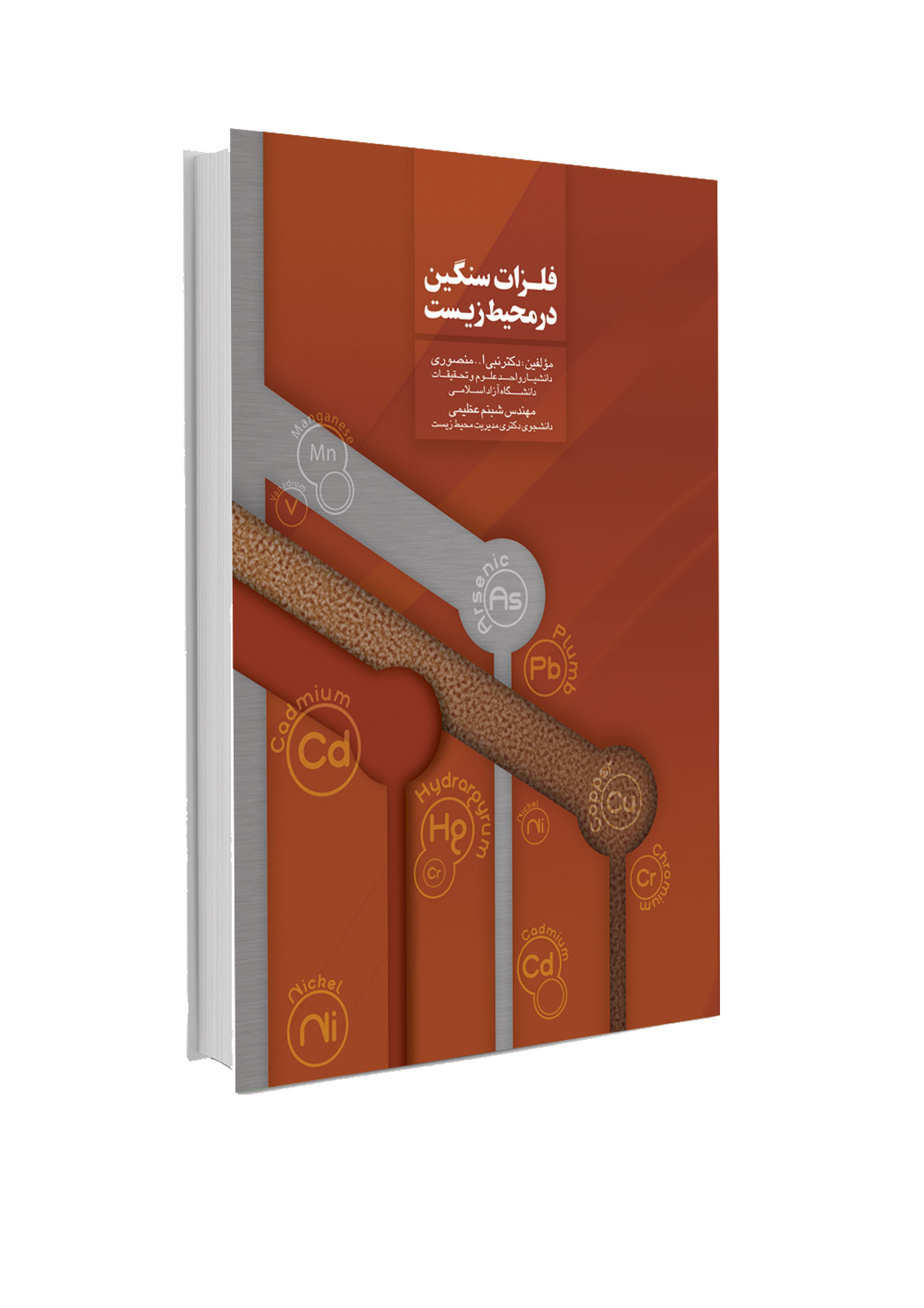 "Heavy Metals In The Environment"[/caption]
The most common of them, which are mainly problematic in industry and the environment and cause a variety of poisonings in exposed individuals, include chromium, cobalt, mercury, cadmium, lead, zinc, copper, and arsenic.
Heavy metals are found naturally and in very small amounts in living ecosystems. These elements are simple, stable pollutants which, unlike their compounds, do not break down in nature through biological and chemical processes.
One of the important consequences of the persistence of heavy metals is their increase in the food chain; so that, as a result of this process, their amount in foodstuffs can rise to several times the amounts found in water or air.
Many of these elements are not only not essential for biological life but are also highly toxic.
Living organisms do not possess them; so that their accumulation in the bodies of living creatures, especially in mammals, causes dangerous diseases.
One of the most important means of their environmental dispersion is emission through polluted air in industrial areas, whereby these elements, through deposition or together with rainfall, enter the soil and surface and groundwater, and also, through runoff into the seas and oceans, contribute to increasing environmental pollution.
Toxic heavy metals have many adverse and harmful effects on health. There are more than 20 different types of toxic metals that have a destructive effect on human health, each causing a different physiological behavior and changes in the person exposed to it. The extent and degree of the toxic effect of heavy metals on the cells or tissue of an organ of the human body depends on the type of toxin and the duration of contact with it.
The present book, in two chapters titled "Fundamentals of Heavy Metals" and "Types of Heavy Metals," addresses these matters fully and comprehensively.
https://irannashr.com/main/product/%d9%81%d9%84%d8%b2%d8%a7%d8%aa-%d8%b3%d9%86%da%af%db%8c%d9%86-%d8%af%d8%b1-%d9%85%d8%ad%db%8c%d8%b7-%d8%b2%db%8c%d8%b3%d8%aa/
"Heavy Metals In The Environment"[/caption]
The most common of them, which are mainly problematic in industry and the environment and cause a variety of poisonings in exposed individuals, include chromium, cobalt, mercury, cadmium, lead, zinc, copper, and arsenic.
Heavy metals are found naturally and in very small amounts in living ecosystems. These elements are simple, stable pollutants which, unlike their compounds, do not break down in nature through biological and chemical processes.
One of the important consequences of the persistence of heavy metals is their increase in the food chain; so that, as a result of this process, their amount in foodstuffs can rise to several times the amounts found in water or air.
Many of these elements are not only not essential for biological life but are also highly toxic.
Living organisms do not possess them; so that their accumulation in the bodies of living creatures, especially in mammals, causes dangerous diseases.
One of the most important means of their environmental dispersion is emission through polluted air in industrial areas, whereby these elements, through deposition or together with rainfall, enter the soil and surface and groundwater, and also, through runoff into the seas and oceans, contribute to increasing environmental pollution.
Toxic heavy metals have many adverse and harmful effects on health. There are more than 20 different types of toxic metals that have a destructive effect on human health, each causing a different physiological behavior and changes in the person exposed to it. The extent and degree of the toxic effect of heavy metals on the cells or tissue of an organ of the human body depends on the type of toxin and the duration of contact with it.
The present book, in two chapters titled "Fundamentals of Heavy Metals" and "Types of Heavy Metals," addresses these matters fully and comprehensively.
https://irannashr.com/main/product/%d9%81%d9%84%d8%b2%d8%a7%d8%aa-%d8%b3%d9%86%da%af%db%8c%d9%86-%d8%af%d8%b1-%d9%85%d8%ad%db%8c%d8%b7-%d8%b2%db%8c%d8%b3%d8%aa/
Comments
No comments yet.
To leave a comment, please sign in.