
Introducing the Book "Environmental Management Systems (Requirements with Guidance for Use)"
شکیلا بختیاریAugust 31, 2016تازه های نشر
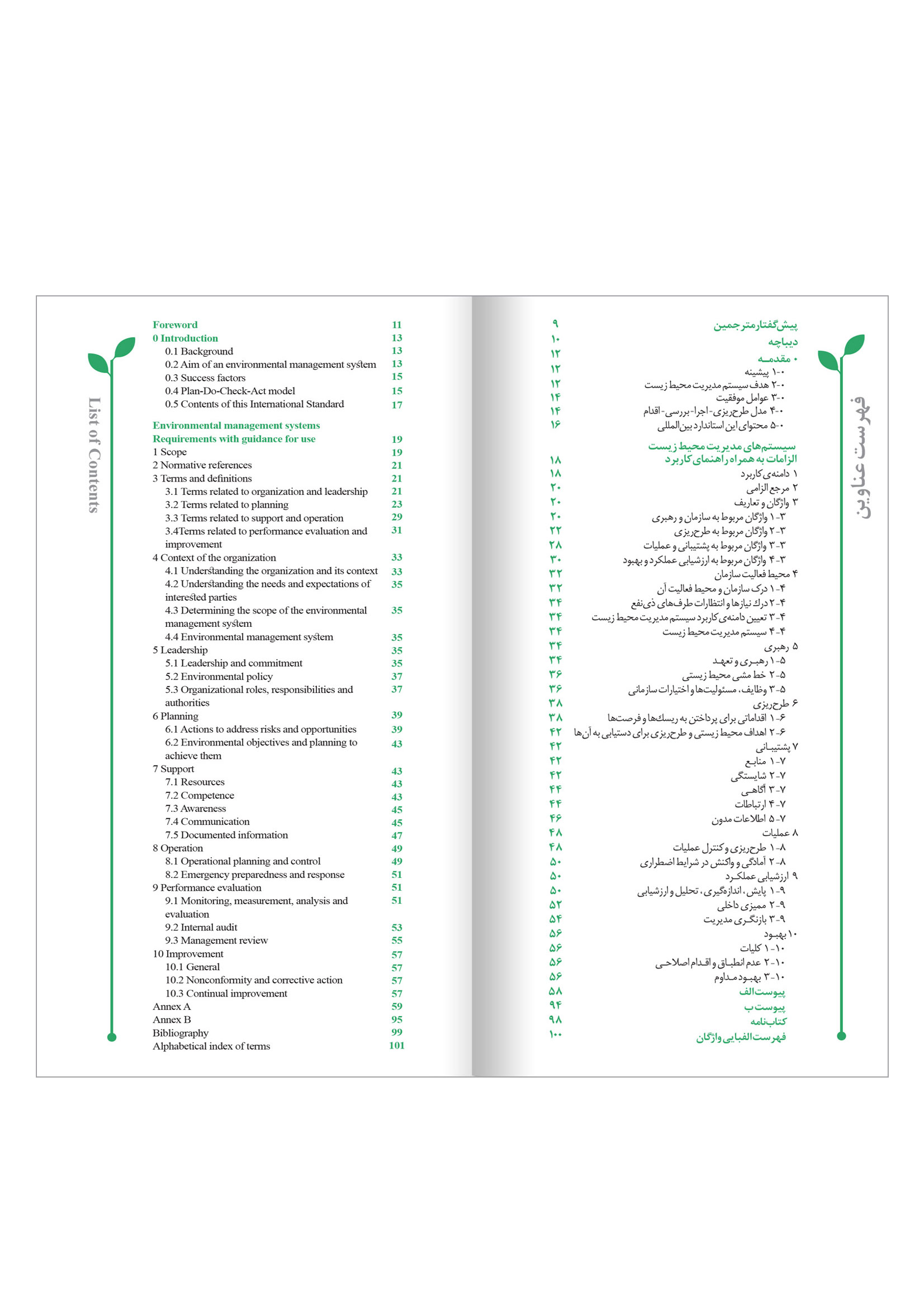
The International Organization for Standardization (ISO) is a worldwide federation of national standards bodies, called ISO members.
The preparation of international standards is normally carried out by the technical committees of the International Organization for Standardization.
Each member, according to its interest in a subject for which a technical committee has been established, has the right to be represented on that committee. International organizations, both governmental and non-governmental, that are in liaison with the International Organization for Standardization (ISO) also participate in this work. The International Organization for Standardization works closely with the International Electrotechnical Commission (IEC) on all matters of electrotechnical standardization.
The procedures used to develop this document and those used for its future maintenance are described in Part 1 of the ISO/IEC Directives.
The various criteria for approving documents of the International Organization for Standardization must be given special attention. The draft of this document was developed in accordance with the editorial rules of Part 2 of the ISO/IEC Directives (for more information, visit www.iso.org/directives).
[caption id="attachment_2568" align="aligncenter" width="280"]
Environmental Management Systems
(ISO 14001:2015)[/caption] It should be noted that some parts of this document may be subject to intellectual property rights. The International Organization for Standardization does not accept responsibility for identifying any or all such intellectual property rights. Further details regarding the identification of intellectual property rights in the process of developing this document are mentioned in the introduction and/or in the ISO list of patent declarations (for more information, visit www.iso.org/patents). Any trade name used in this document is information for the convenience of users and does not constitute an endorsement of it. For an explanation of the meanings of certain specific ISO terms and expressions related to conformity assessment, as well as information about ISO's adherence to the World Trade Organization (WTO) principles concerning Technical Barriers to Trade (TBT), visit www.iso.org/foreword.html. The committee responsible for this document is Subcommittee No. 1 (Environmental Management Systems), which operates under Technical Committee No. 207 of the International Organization for Standardization (Environmental Management). This edition is the third revision of this international standard, which cancels and replaces the second edition (ISO 14001:2004), which has been technically revised. This document also incorporates Amendment No. 1 to ISO 14001:2004 of 2009. Achieving a balance between the environment, society, and the economy is considered essential for meeting the needs of the present generation without compromising the ability of future generations to meet their needs. Sustainable development, as a long-term goal, is achieved by creating a balance among the three pillars of sustainability. With regulations becoming increasingly stringent and with growing pressures on the environment from pollution, inefficient use of resources, improper waste management, climate change, ecosystem degradation, and damage to biodiversity, social expectations for sustainable development, transparency, and accountability have increased sharply. This has caused organizations to adopt a systematic approach to environmental management, with the aim of contributing to the environmental pillar of sustainability, by establishing environmental management systems. The aim of this international standard is to provide a framework for protecting the environment and responding to changing environmental conditions while balancing socio-economic needs. The specific requirements of this standard can enable an organization to achieve the intended outcomes it has set for its environmental management system. A systematic approach to environmental management can provide top management with the information needed to achieve long-term success and provide options for contributing to sustainable development by means of the following: - protecting the environment by preventing or mitigating adverse environmental impacts - mitigating the potential adverse effects of environmental conditions on the organization - enhancing environmental performance - controlling or influencing the way the organization's products and services are designed, produced, distributed, consumed, and disposed of, using a life-cycle perspective that can prevent the unintended transfer of environmental impacts throughout the life cycle - achieving financial and operational benefits that can result from implementing appropriate environmental solutions, ultimately strengthening the organization's position in the market - communicating environmental information to relevant interested parties Like other international standards, this international standard does not intend to increase or change an organization's legal requirements. https://irannashr.com/main/product/%d8%b3%db%8c%d8%b3%d8%aa%d9%85-%d9%87%d8%a7%db%8c-%d9%85%d8%af%db%8c%d8%b1%db%8c%d8%aa-%d9%85%d8%ad%db%8c%d8%b7-%d8%b2%db%8c%d8%b3%d8%aa/
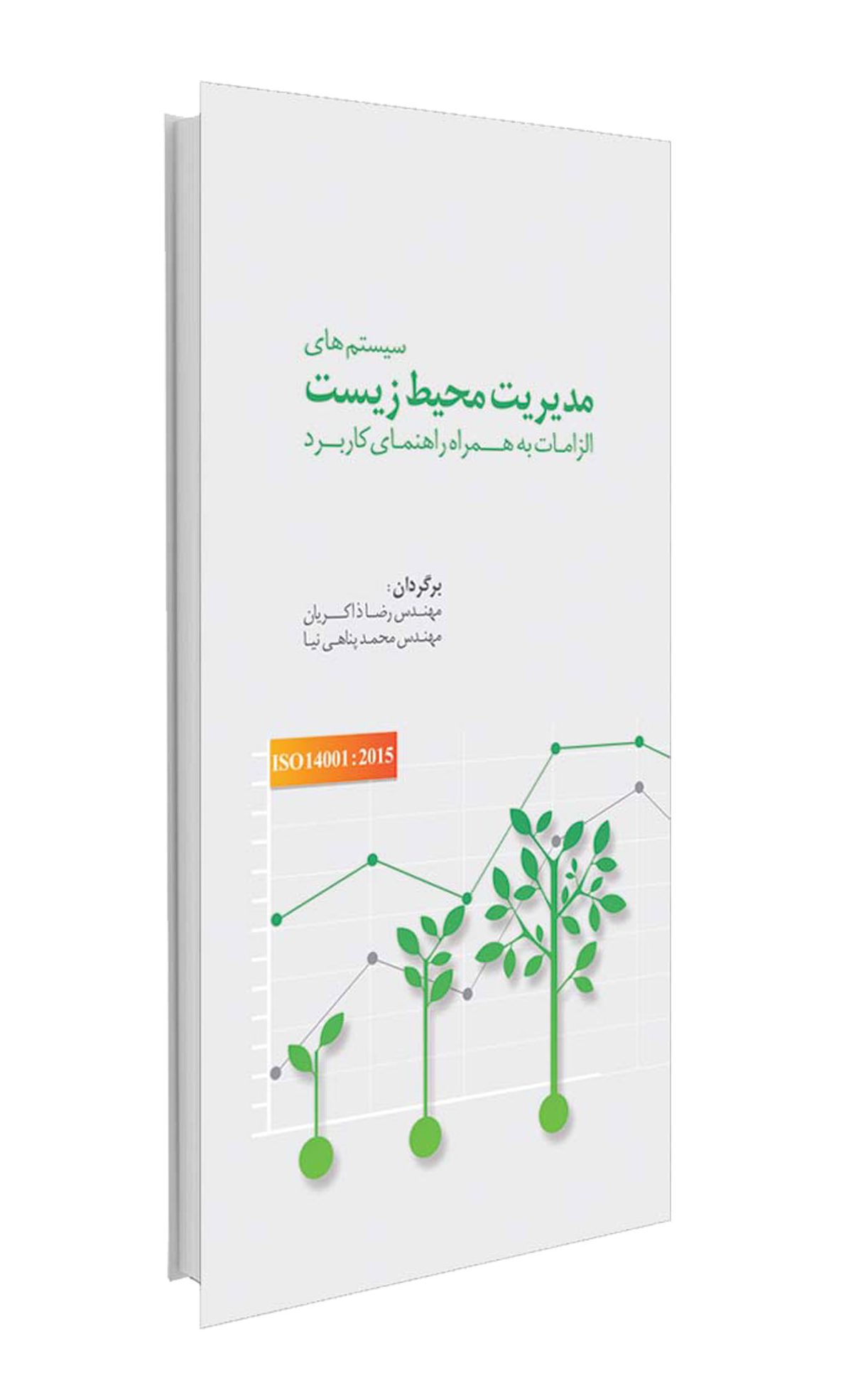
Environmental Management Systems
(ISO 14001:2015)[/caption] It should be noted that some parts of this document may be subject to intellectual property rights. The International Organization for Standardization does not accept responsibility for identifying any or all such intellectual property rights. Further details regarding the identification of intellectual property rights in the process of developing this document are mentioned in the introduction and/or in the ISO list of patent declarations (for more information, visit www.iso.org/patents). Any trade name used in this document is information for the convenience of users and does not constitute an endorsement of it. For an explanation of the meanings of certain specific ISO terms and expressions related to conformity assessment, as well as information about ISO's adherence to the World Trade Organization (WTO) principles concerning Technical Barriers to Trade (TBT), visit www.iso.org/foreword.html. The committee responsible for this document is Subcommittee No. 1 (Environmental Management Systems), which operates under Technical Committee No. 207 of the International Organization for Standardization (Environmental Management). This edition is the third revision of this international standard, which cancels and replaces the second edition (ISO 14001:2004), which has been technically revised. This document also incorporates Amendment No. 1 to ISO 14001:2004 of 2009. Achieving a balance between the environment, society, and the economy is considered essential for meeting the needs of the present generation without compromising the ability of future generations to meet their needs. Sustainable development, as a long-term goal, is achieved by creating a balance among the three pillars of sustainability. With regulations becoming increasingly stringent and with growing pressures on the environment from pollution, inefficient use of resources, improper waste management, climate change, ecosystem degradation, and damage to biodiversity, social expectations for sustainable development, transparency, and accountability have increased sharply. This has caused organizations to adopt a systematic approach to environmental management, with the aim of contributing to the environmental pillar of sustainability, by establishing environmental management systems. The aim of this international standard is to provide a framework for protecting the environment and responding to changing environmental conditions while balancing socio-economic needs. The specific requirements of this standard can enable an organization to achieve the intended outcomes it has set for its environmental management system. A systematic approach to environmental management can provide top management with the information needed to achieve long-term success and provide options for contributing to sustainable development by means of the following: - protecting the environment by preventing or mitigating adverse environmental impacts - mitigating the potential adverse effects of environmental conditions on the organization - enhancing environmental performance - controlling or influencing the way the organization's products and services are designed, produced, distributed, consumed, and disposed of, using a life-cycle perspective that can prevent the unintended transfer of environmental impacts throughout the life cycle - achieving financial and operational benefits that can result from implementing appropriate environmental solutions, ultimately strengthening the organization's position in the market - communicating environmental information to relevant interested parties Like other international standards, this international standard does not intend to increase or change an organization's legal requirements. https://irannashr.com/main/product/%d8%b3%db%8c%d8%b3%d8%aa%d9%85-%d9%87%d8%a7%db%8c-%d9%85%d8%af%db%8c%d8%b1%db%8c%d8%aa-%d9%85%d8%ad%db%8c%d8%b7-%d8%b2%db%8c%d8%b3%d8%aa/
Comments
No comments yet.
To leave a comment, please sign in.