
Stretching Exercises
Relaxing exercises for the back, shoulders, and arms 1/Raise your hands above your head behind you and, while pressing them together, stretch them upward. Be careful to keep your lower body firmly on the floor, without contracting the muscles or the lower back. Do this exercise twice, each time for ten seconds.(Figure 5) 2/To stretch and strengthen the shoulders and upper back, pull your arm across to the opposite side of the chest with the opposite hand as shown below, and while pressing it from the elbow area, bring the stretched arm onto the opposite shoulder. Be careful to keep your head and neck straight, and let only the arms move, not the head or the lower back. Do the exercise twice for each arm for ten seconds.(Figure 6) 3/Interlace your fingers and push them forward slightly above shoulder level, while keeping your head and neck straight and looking forward. Do the exercise for 15 seconds.(Figure 7) 4/Interlace your fingers as in the previous figure, except that this time stretch your arms upward in line with the shoulders and parallel to the head and neck. Do this exercise for ten seconds and, without stopping, in this same position contract the muscles of the legs, lower back, and abdomen, increasing the stretching tension of the arms, and remain in this final position for 10 seconds. Do the exercise twice.(Figure 8) 5/To strengthen the muscles of the upper shoulder and the muscles on the sides of the neck and the back of the arm, keep your head straight and then turn it toward your left shoulder (as far as is possible for you and you feel no pain), and at the same time grasp your right wrist from behind with your left hand and pull. Do the exercise twice for each side for 10 seconds.(Figure 9)
 Relaxing exercises for the lower back and spine
Before performing the exercises, it should be noted that if you have spinal problems, especially a disc problem, or feel that you do, be sure to consult your treating physician. It may be necessary to do certain exercises for a while, or to refrain from exercising for some time and rest. In any case, do the exercises with calm and particular gentleness so that the back muscles get used to them. Another point is that, as a rule, do the lying-down exercises on firm surfaces, not on hard surfaces! If the surface beneath you is hard (tile, ceramic, a tartan track, the ground), it will be difficult—and perhaps impossible—for the exercises to give optimal results. Spreading out a large folded towel makes the task easier.
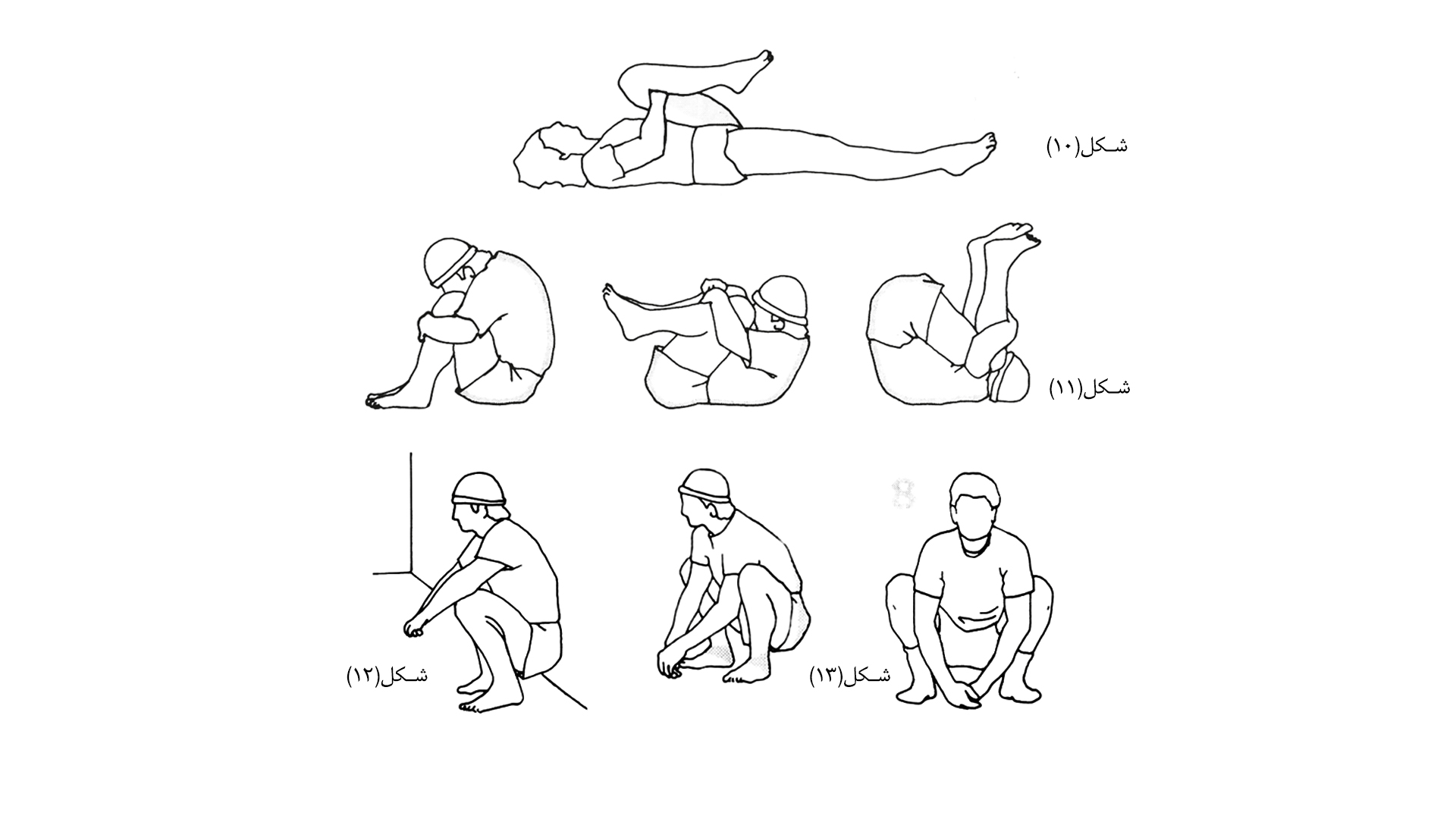
1/Lie on your back on the floor and grasp your left leg below the kneecap with both hands, pulling it toward your chest, while keeping your right leg fully extended and bending the toes outward. Keep your head and neck on the floor and relax their muscles. Do this exercise twice, each time for 10 seconds for each leg.(Figure 10)
2/Hug your knees and, as in the figure, roll back onto your spine, and while holding your knees, remain in the final position for a moment, then bring the body forward again, then repeat the movement.(Figure 11)
3/Now grasp your legs below the kneecaps and gently roll back onto your back. At first it is difficult, but try to feel the rolling motion on each vertebra of the spine. That is, roll back vertebra by vertebra! Keep your head and neck on the floor and gently return to the starting position. Do the exercise 5 times.
4/From a standing position, with your feet directed outward at an angle of about 15 degrees and about 20 to 30 centimeters apart, and the soles of your feet on the floor, slowly go down and remain in the final position for 15 seconds. For some this movement is difficult. Be careful not to create excess stretching pressure, so that you can gradually perform the exercise with ease. Also, in such movements you should not feel pain in the knee and kneecap area. If you do, stop the exercise.(Figure 12)
5/To complete the stretch in the lower body, position yourself as in the figure below, place your elbows on your thighs and push outward, while gently and with very little pressure from the buttocks and lower back, bending the body forward. Although keeping your balance is difficult, raise your heels slightly off the floor. Do this exercise also for 15 seconds.(Figure 13)
Relaxing exercises for the lower back and spine
Before performing the exercises, it should be noted that if you have spinal problems, especially a disc problem, or feel that you do, be sure to consult your treating physician. It may be necessary to do certain exercises for a while, or to refrain from exercising for some time and rest. In any case, do the exercises with calm and particular gentleness so that the back muscles get used to them. Another point is that, as a rule, do the lying-down exercises on firm surfaces, not on hard surfaces! If the surface beneath you is hard (tile, ceramic, a tartan track, the ground), it will be difficult—and perhaps impossible—for the exercises to give optimal results. Spreading out a large folded towel makes the task easier.
1/Lie on your back on the floor and grasp your left leg below the kneecap with both hands, pulling it toward your chest, while keeping your right leg fully extended and bending the toes outward. Keep your head and neck on the floor and relax their muscles. Do this exercise twice, each time for 10 seconds for each leg.(Figure 10)
2/Hug your knees and, as in the figure, roll back onto your spine, and while holding your knees, remain in the final position for a moment, then bring the body forward again, then repeat the movement.(Figure 11)
3/Now grasp your legs below the kneecaps and gently roll back onto your back. At first it is difficult, but try to feel the rolling motion on each vertebra of the spine. That is, roll back vertebra by vertebra! Keep your head and neck on the floor and gently return to the starting position. Do the exercise 5 times.
4/From a standing position, with your feet directed outward at an angle of about 15 degrees and about 20 to 30 centimeters apart, and the soles of your feet on the floor, slowly go down and remain in the final position for 15 seconds. For some this movement is difficult. Be careful not to create excess stretching pressure, so that you can gradually perform the exercise with ease. Also, in such movements you should not feel pain in the knee and kneecap area. If you do, stop the exercise.(Figure 12)
5/To complete the stretch in the lower body, position yourself as in the figure below, place your elbows on your thighs and push outward, while gently and with very little pressure from the buttocks and lower back, bending the body forward. Although keeping your balance is difficult, raise your heels slightly off the floor. Do this exercise also for 15 seconds.(Figure 13)
Comments
No comments yet.
To leave a comment, please sign in.