
Toxic Gas Testing in the Oil Industry
اسماعیلیNovember 28, 2024اخبار

Testing for toxic substances must be carried out based on a job analysis. Reviewing the Material Safety Data Sheets (MSDS) used or kept at the location in question can show us the likely presence of these substances along with the permissible limits of contact with them.
Toxic and harmful gases can be divided into two subgroups:
1- Simple asphyxiant gases: The displacement of the oxygen present in the air we breathe by any of these gases can lead to suffocation. (such as nitrogen and argon gas)
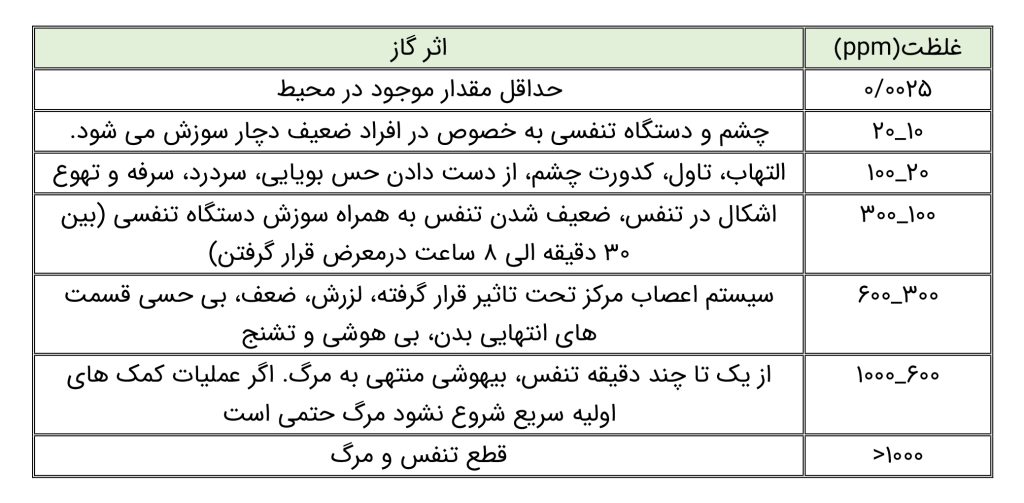
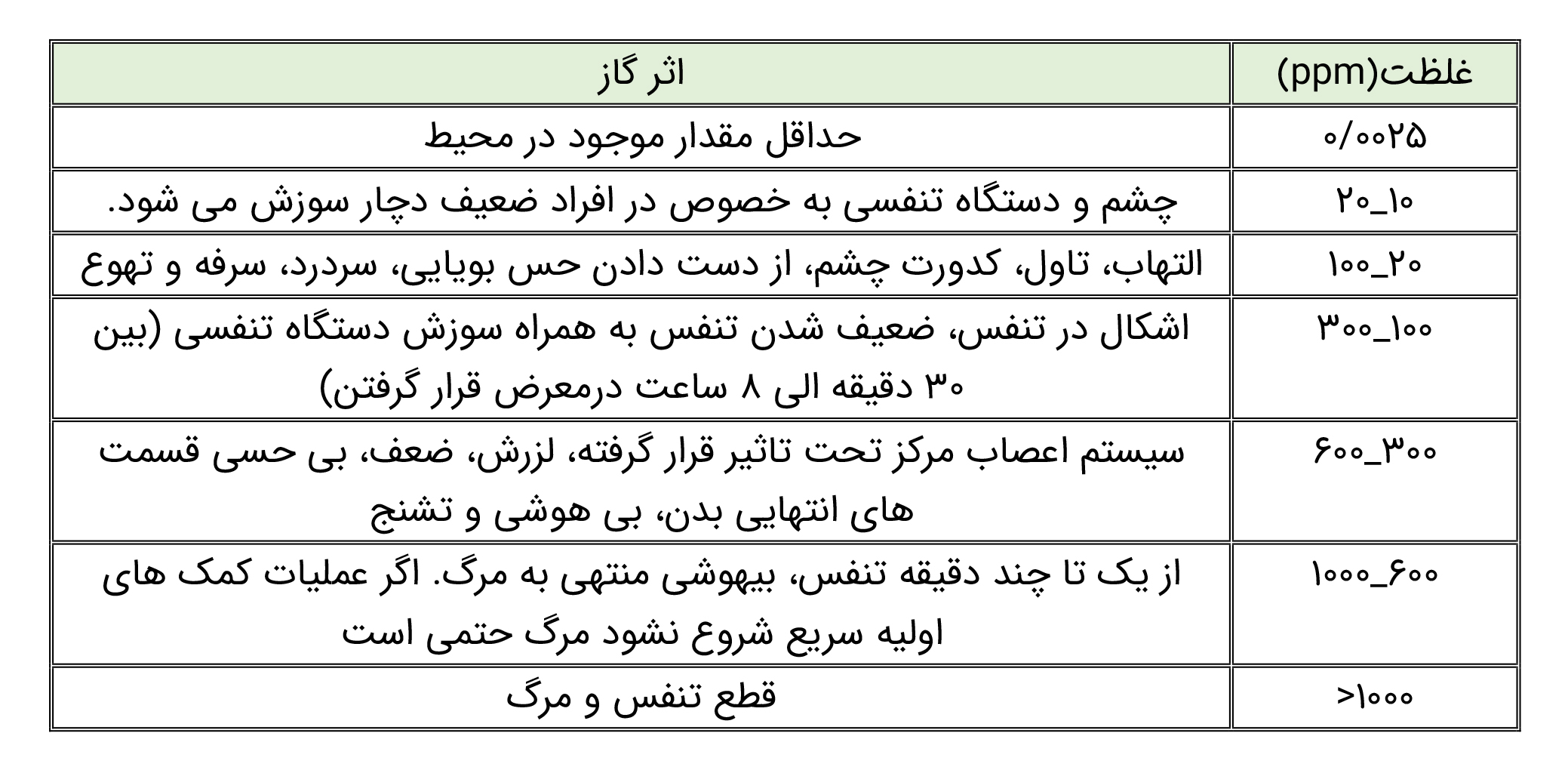
2- Toxic asphyxiant gases: This type of toxic gas interferes chemically with the vital processes that exist inside the body. Given that small amounts of these gases in the ambient air can cause poisoning in humans, for this reason units of parts per million are used to measure them. Some toxic gases can be flammable at high concentrations; for example, hydrogen sulfide gas has values of 3.4% for its lower flammable limit and 46% for its upper flammable limit. Therefore it can be said that its explosive range is between 43,000 ppm and 46,000 ppm. It must be borne in mind that very small amounts of hydrogen sulfide can cause instant death.
The table below shows the effects of hydrogen sulfide gas on humans at various concentrations.
 Another of the most well-known lethal gases is carbon monoxide. Carbon monoxide is not toxic in itself, but when it enters the human lungs it combines with the hemoglobin of the blood and prevents the supply of oxygen to the body's internal cells. If carbon monoxide is continuously inhaled, the body faces an oxygen deficiency, and it first affects the central nervous system, namely the brain and spinal cord. This leads to headache, dizziness, ringing in the ears, palpitations, rapid pulse, and vomiting; likewise in some people cases such as insomnia and forgetfulness have been reported.
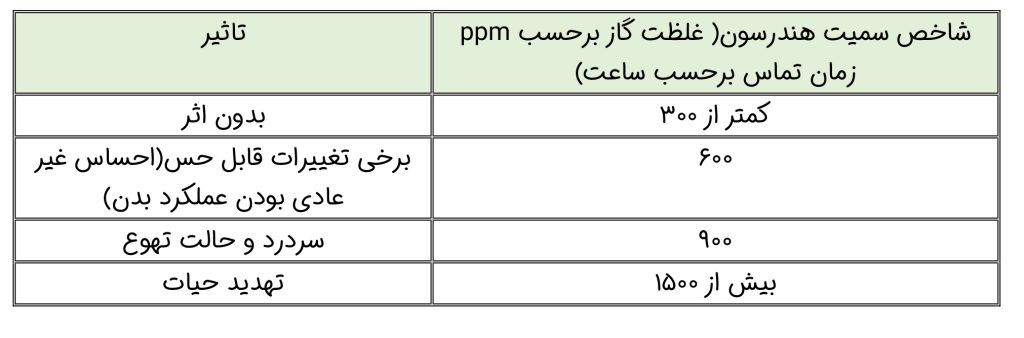
The table below shows the effects of carbon monoxide gas on the body at various concentrations based on the Henderson index.
Another of the most well-known lethal gases is carbon monoxide. Carbon monoxide is not toxic in itself, but when it enters the human lungs it combines with the hemoglobin of the blood and prevents the supply of oxygen to the body's internal cells. If carbon monoxide is continuously inhaled, the body faces an oxygen deficiency, and it first affects the central nervous system, namely the brain and spinal cord. This leads to headache, dizziness, ringing in the ears, palpitations, rapid pulse, and vomiting; likewise in some people cases such as insomnia and forgetfulness have been reported.
The table below shows the effects of carbon monoxide gas on the body at various concentrations based on the Henderson index.
 Permissible limits of exposure to toxic gas
The minimum amount of a toxic gas that is permissible at the workplace is presented by international safety and health organizations under the title of exposure limits; this in fact expresses the length of time a person can be exposed to a specified concentration of a pollutant. Permissible occupational-exposure limits for chemical agents are presented in three groups: 1) time-weighted average, 2) short-term occupational-exposure limit, 3) ceiling permissible exposure limit, with various and complementary applications. For some substances such as irritant gases, only the ceiling permissible exposure limit applies. If the level of exposure of workers exceeds any of the three presented limits, there will be a likelihood of occupational hazards arising from that chemical substance.
Finally, oil industries contain very large amounts of flammable and toxic substances, so the potential for serious accidents always exists. To prevent such accidents, the existence of management systems for organizing and performing work safely is vital. You, dear readers, can also, by obtaining the book Work Permits in the Oil Industry, a work by Mr. Koroush Pak Bin, Mr. Hossein Mahmoud Janloo, and Mr. Ebrahim Parsa Amoughin, gain complete and comprehensive information about management systems and work permits in the oil industry.
Permissible limits of exposure to toxic gas
The minimum amount of a toxic gas that is permissible at the workplace is presented by international safety and health organizations under the title of exposure limits; this in fact expresses the length of time a person can be exposed to a specified concentration of a pollutant. Permissible occupational-exposure limits for chemical agents are presented in three groups: 1) time-weighted average, 2) short-term occupational-exposure limit, 3) ceiling permissible exposure limit, with various and complementary applications. For some substances such as irritant gases, only the ceiling permissible exposure limit applies. If the level of exposure of workers exceeds any of the three presented limits, there will be a likelihood of occupational hazards arising from that chemical substance.
Finally, oil industries contain very large amounts of flammable and toxic substances, so the potential for serious accidents always exists. To prevent such accidents, the existence of management systems for organizing and performing work safely is vital. You, dear readers, can also, by obtaining the book Work Permits in the Oil Industry, a work by Mr. Koroush Pak Bin, Mr. Hossein Mahmoud Janloo, and Mr. Ebrahim Parsa Amoughin, gain complete and comprehensive information about management systems and work permits in the oil industry.
 Another of the most well-known lethal gases is carbon monoxide. Carbon monoxide is not toxic in itself, but when it enters the human lungs it combines with the hemoglobin of the blood and prevents the supply of oxygen to the body's internal cells. If carbon monoxide is continuously inhaled, the body faces an oxygen deficiency, and it first affects the central nervous system, namely the brain and spinal cord. This leads to headache, dizziness, ringing in the ears, palpitations, rapid pulse, and vomiting; likewise in some people cases such as insomnia and forgetfulness have been reported.
The table below shows the effects of carbon monoxide gas on the body at various concentrations based on the Henderson index.
Another of the most well-known lethal gases is carbon monoxide. Carbon monoxide is not toxic in itself, but when it enters the human lungs it combines with the hemoglobin of the blood and prevents the supply of oxygen to the body's internal cells. If carbon monoxide is continuously inhaled, the body faces an oxygen deficiency, and it first affects the central nervous system, namely the brain and spinal cord. This leads to headache, dizziness, ringing in the ears, palpitations, rapid pulse, and vomiting; likewise in some people cases such as insomnia and forgetfulness have been reported.
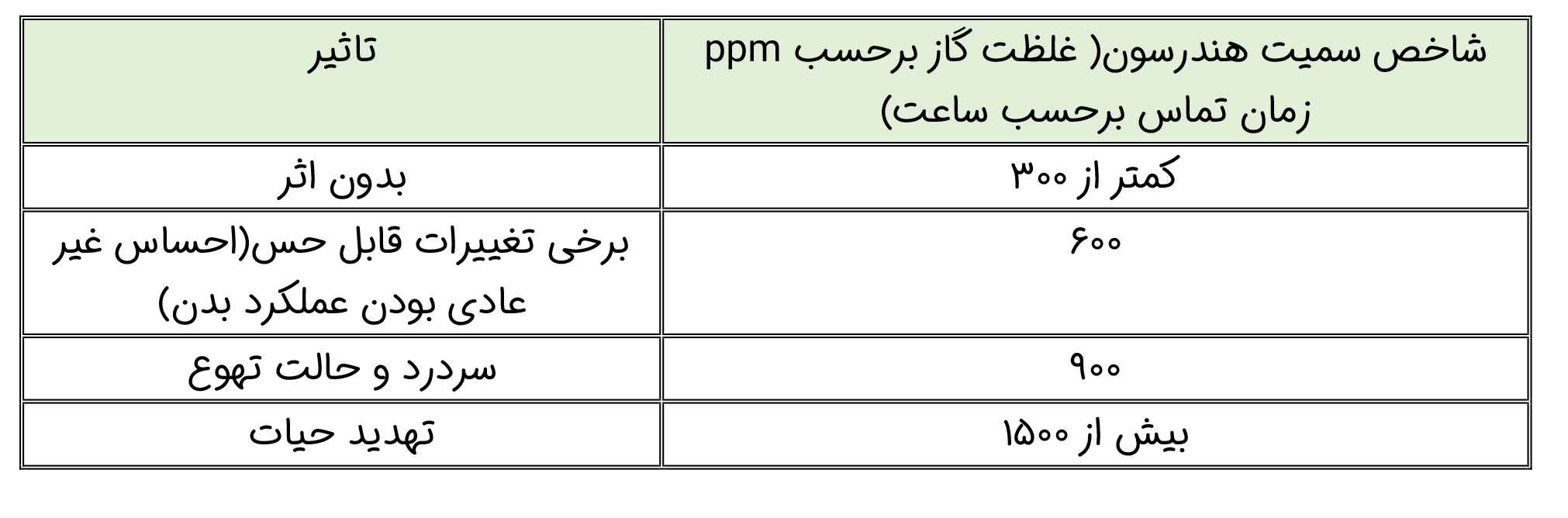
The table below shows the effects of carbon monoxide gas on the body at various concentrations based on the Henderson index.
 Permissible limits of exposure to toxic gas
The minimum amount of a toxic gas that is permissible at the workplace is presented by international safety and health organizations under the title of exposure limits; this in fact expresses the length of time a person can be exposed to a specified concentration of a pollutant. Permissible occupational-exposure limits for chemical agents are presented in three groups: 1) time-weighted average, 2) short-term occupational-exposure limit, 3) ceiling permissible exposure limit, with various and complementary applications. For some substances such as irritant gases, only the ceiling permissible exposure limit applies. If the level of exposure of workers exceeds any of the three presented limits, there will be a likelihood of occupational hazards arising from that chemical substance.
Finally, oil industries contain very large amounts of flammable and toxic substances, so the potential for serious accidents always exists. To prevent such accidents, the existence of management systems for organizing and performing work safely is vital. You, dear readers, can also, by obtaining the book Work Permits in the Oil Industry, a work by Mr. Koroush Pak Bin, Mr. Hossein Mahmoud Janloo, and Mr. Ebrahim Parsa Amoughin, gain complete and comprehensive information about management systems and work permits in the oil industry.
Permissible limits of exposure to toxic gas
The minimum amount of a toxic gas that is permissible at the workplace is presented by international safety and health organizations under the title of exposure limits; this in fact expresses the length of time a person can be exposed to a specified concentration of a pollutant. Permissible occupational-exposure limits for chemical agents are presented in three groups: 1) time-weighted average, 2) short-term occupational-exposure limit, 3) ceiling permissible exposure limit, with various and complementary applications. For some substances such as irritant gases, only the ceiling permissible exposure limit applies. If the level of exposure of workers exceeds any of the three presented limits, there will be a likelihood of occupational hazards arising from that chemical substance.
Finally, oil industries contain very large amounts of flammable and toxic substances, so the potential for serious accidents always exists. To prevent such accidents, the existence of management systems for organizing and performing work safely is vital. You, dear readers, can also, by obtaining the book Work Permits in the Oil Industry, a work by Mr. Koroush Pak Bin, Mr. Hossein Mahmoud Janloo, and Mr. Ebrahim Parsa Amoughin, gain complete and comprehensive information about management systems and work permits in the oil industry.
Comments
No comments yet.
To leave a comment, please sign in.